

The Complete Guide to African Plant Oils in Skincare
Walk into any well-stocked natural beauty store and you will find shelves of facial oils from all over the world. Argan from Morocco, rosehip from Chile, sea buckthorn from the Himalayas. They are all marketed as the best. But look at the actual data on fatty acid profiles, antioxidant content, and stability, and one region keeps coming up: southern Africa, and specifically the semi-arid zone stretching across the Kalahari.
This is not marketing. The plants that survive in the Kalahari have evolved over millions of years to cope with the same things that damage human skin: intense UV radiation, severe moisture loss, and oxidative stress from environmental exposure. The oils pressed from their seeds and fruits carry that protection in concentrated form. This guide breaks down the science behind why these oils work, what makes them different from the alternatives, and how to choose the right one for your skin type.
Why Plant Oils Work: The Basics of Fatty Acids
A facial oil is only as good as its fatty acid profile. Fatty acids are the building blocks of plant oils, and different fatty acids do different things when they come into contact with your skin.
The two most relevant for skincare are oleic acid and linoleic acid. Oleic acid (omega-9) is a monounsaturated fat found in high concentrations in Marula Oil and olive oil. It penetrates the upper layers of skin relatively easily, making it nourishing and occlusive. It is the go-to for dry, mature, or dehydrated skin. Linoleic acid (omega-6) is a polyunsaturated fat found in high concentrations in Kalahari Melon Seed Oil and rosehip oil. It is lighter, non-comedogenic, and research has connected low skin linoleic levels with clogged pores and acne. For oily and acne-prone skin, high-linoleic oils are almost always the better choice.
Understanding this one distinction, oleic vs linoleic, gets you most of the way toward picking the right oil for your skin. For a full breakdown with numbers for each oil, see our guide on oleic acid vs linoleic acid and what each one does for your skin.
Cold-Pressed vs. Refined: Why It Matters More Than You Think
Once you know which fatty acid profile suits your skin, the next thing to look at is how the oil was extracted. This is where a lot of skincare products quietly cut corners.
Cold-pressed oils are extracted purely by mechanical pressure, without heat above a certain threshold and without chemical solvents like hexane. This preserves the fatty acids intact, along with the plant sterols, tocopherols, carotenoids, and other bioactive compounds that give the oil its actual skincare benefits. Refined oils go through additional processing steps, including bleaching and deodorizing, that strip out many of these active compounds. The end result is an oil that is purer in a narrow sense but significantly less effective.
For skincare purposes, cold-pressed is almost always the right choice. The higher price reflects the lower yield and more careful process. If a product does not specify cold-pressed or unrefined on the label, assume it has been processed. For the full breakdown of what refining actually removes, read our article on cold-pressed vs refined plant oils and what the difference means for your skin.
The Oil Science Cluster: Six Posts Worth Reading
This guide is designed as a hub. The six articles linked below go deeper on individual pieces of the science. You do not need to read all of them, but each one adds a useful layer to what is covered here.
- The Science of Linoleic Acid: Why Your Skin Needs This Essential Fatty Acid covers the biochemistry of linoleic acid, why the skin cannot produce it on its own, and what happens when linoleic levels drop in the skin barrier.
- Baobab Oil Benefits for Skin and Hair: The Tree of Life Explained breaks down the unusually broad vitamin profile of Baobab Oil and why it works well for compromised or very dry skin.
- Cold-Pressed vs. Refined Plant Oils explains what the refining process removes and why it matters when you are buying a facial oil.
- Oleic Acid vs. Linoleic Acid is the clearest single reference for matching fatty acid profiles to skin types.
- Understanding Comedogenic Ratings explains the 0 to 5 scale and lists ratings for the most commonly used facial oils so you can quickly check whether an oil is suitable for your skin type.
- Natural Retinol Alternatives: Which Plant Oils Actually Work? compares plant-based retinol alternatives including Bakuchiol, rosehip, and sea buckthorn against each other and against synthetic retinoids.
The African Oils: What Each One Does
Kalahari Melon Seed Oil
Pressed from the seeds of Citrullus lanatus, a wild watermelon native to the Kalahari, this oil has a linoleic acid content of 65 to 75 percent. That makes it one of the most lightweight and non-comedogenic oils available anywhere. It rates 0 to 1 on the comedogenic scale. It is rich in vitamin E and beta-carotene, absorbs quickly without leaving a greasy finish, and actively supports the skin barrier. It is the best single oil for oily, combination, or acne-prone skin in the Kalahari Rose range.
The plant itself evolved in one of the driest environments on earth. To retain moisture across months of extreme heat with almost no rainfall, the seeds of the Kalahari Melon developed a dense store of protective lipids. That moisture-retention chemistry translates directly to the skin.
Marula Oil
Pressed from the kernels of the Sclerocarya birrea tree, Marula Oil is 70 to 78 percent oleic acid. It absorbs relatively fast for an oleic-dominant oil, leaves no heavy residue, and carries a significant antioxidant load. Studies have found Marula Oil to be more resistant to oxidation than argan oil, meaning it stays active on skin longer after application rather than going rancid quickly. It rates 3 to 4 on the comedogenic scale, so it is best for dry, normal, or mature skin rather than oily or acne-prone types.
Marula is perhaps the most widely recognized African botanical ingredient in premium skincare, and with good reason. The tree grows across sub-Saharan Africa and has been used by local communities for skin and hair care for generations, long before it appeared on Western beauty shelves. At Kalahari Rose, our Marula Oil is cold-pressed and unrefined, which means the full fatty acid profile and antioxidant content are preserved.
Baobab Oil
Baobab Oil comes from the seeds of Adansonia digitata, Africa's iconic Tree of Life. It contains an unusually broad vitamin profile, including vitamins A, D, E, and F (essential fatty acids), along with a blend of palmitic, oleic, and linoleic acids. That combination makes it well suited for very dry, flaky, or compromised skin. It is deeply nourishing, absorbs slowly compared to lighter oils, and works particularly well as an overnight treatment. For more on Baobab Oil's full range of benefits, see our dedicated Baobab Oil guide.
Rooibos Extract
Rooibos (Aspalathus linearis) is not technically an oil but it is worth including in any serious discussion of African botanicals. It contains aspalathin, a C-glucoside flavonoid found nowhere else in the plant kingdom. It is a potent antioxidant and has shown meaningful anti-inflammatory activity in clinical research. In formulations, Rooibos extract helps neutralize free radical damage from UV exposure and environmental pollution while visibly calming redness. For a deeper look at how antioxidants work in skincare and why not all antioxidants are equal, see our guide on antioxidants in skincare.
African Plant Oils vs. European and South American Alternatives
Argan oil from Morocco, rosehip from Chile, sea buckthorn from the Himalayas, these are the oils that dominated the premium facial oil market for the last decade. They are good oils. But comparing their fatty acid profiles, antioxidant content, and stability to the African alternatives reveals some meaningful differences.
Argan oil is roughly 45 percent oleic and 35 percent linoleic, which puts it somewhere in the middle. It is a solid all-around oil but does not specialize as strongly as either Marula (which goes deeper for dry skin) or Kalahari Melon Seed (which is better for oily skin). Argan oil also oxidizes faster than Marula under comparable conditions. Rosehip oil is high in linoleic acid and trans-retinoic acid, which accounts for its reputation as a natural retinol alternative, but it is one of the least stable oils available and tends to go rancid relatively quickly unless properly formulated. For a full side-by-side comparison, read African botanicals vs European botanicals: a skincare comparison.
How to Choose the Right Oil for Your Skin Type
The general principle is straightforward. Oily and acne-prone skin should go with high-linoleic, low-comedogenic oils. Dry and mature skin should go with high-oleic, more nourishing oils. Combination skin can use either depending on where it is applied. Sensitive skin should patch-test everything and look for oils with anti-inflammatory properties like Rooibos extract.
For the step-by-step process of identifying your skin type and matching it to an oil, see the How to Choose section at the bottom of this page. And for a detailed comedogenic rating chart covering the most common facial oils, check our full comedogenic ratings guide.
Plant Oils as Natural Retinol Alternatives
Retinol, the gold standard for anti-aging in conventional skincare, is off the table for pregnant women, nursing mothers, and anyone whose skin reacts badly to it. Plant oils offer credible alternatives, particularly Bakuchiol, a compound derived from the seeds of Psoralea corylifolia. Bakuchiol has been shown in clinical trials to upregulate the same genes as retinol and produce comparable improvements in fine lines and skin tone without the irritation, sensitivity, and sun-exposure limitations that come with synthetic retinoids.
Rosehip and sea buckthorn oils contain trans-retinoic acid at low concentrations, which contributes to their anti-aging effects but also to their instability. Marula and Baobab do not contain retinol precursors but their antioxidant profiles make them effective at slowing the oxidative damage that accelerates skin aging. For a full comparison of all the plant-based retinol options and how they stack up against each other, see natural retinol alternatives: which plant oils actually work.
How to Apply Facial Oil in Your Routine
The most common question about facial oils is where they go in a routine. The answer depends slightly on the texture of your specific oil and the other products you are using, but the general rule is: oil goes after water-based serums and before or blended into your moisturizer.
The reason is layering logic. Water-based serums absorb into skin on their own and then the oil is applied over them to seal in that hydration and prevent moisture evaporation, what skincare chemists call transepidermal water loss (TEWL). If you apply oil first, you create a lipid barrier that blocks the water-based serum from absorbing properly. For a deeper look at how moisture leaves the skin and why occlusive layers matter, read our article on transepidermal water loss and why it matters for your skin.
At night, applying oil as the last step before sleep takes advantage of the skin's natural overnight repair cycle. Morning application should be followed by SPF after the oil has absorbed.
The Kalahari Rose Approach
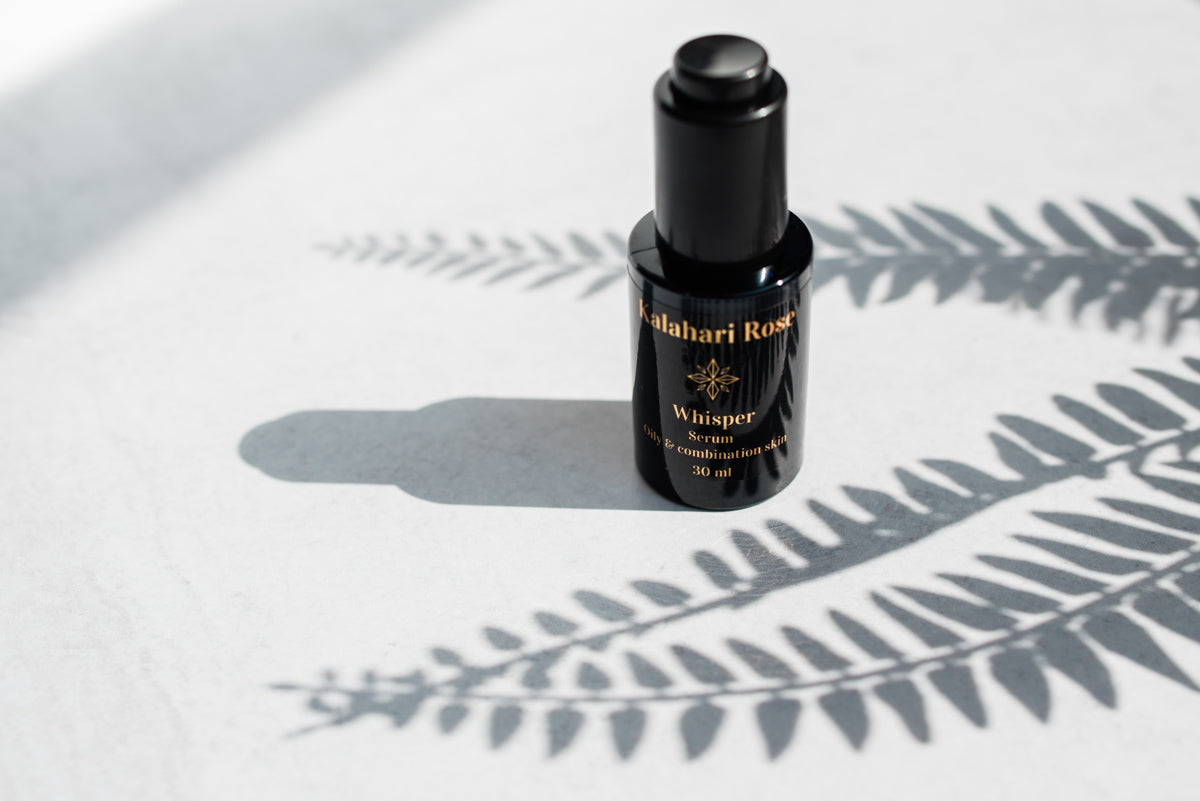
Every Kalahari Rose product is built around these same African botanicals, cold-pressed and unrefined, without parabens, synthetic fragrances, or petrochemicals. For oily and combination skin, the Whisper Face Serum leads with Kalahari Melon Seed Oil, keeping the formula lightweight and non-comedogenic. For dry and mature skin, the Royal Serum is built around Marula Oil for deeper nourishment. The Sunlight Deep Healing Oil is a concentrated treatment for very dry, damaged, or compromised skin that benefits from the broader vitamin profile of Baobab.
For a full guide to building a routine with these oils from scratch, including how to layer them with serums and creams, see our guide to building a minimalist routine with natural oils.
How to Choose the Right African Plant Oil for Your Skin Type
The five steps below walk you through the selection process from skin type identification to patch testing and layering. If you want to skip straight to a recommendation, the short version is: oily skin goes with Kalahari Melon Seed Oil (Whisper Serum), dry skin goes with Marula (Royal Serum), and combination skin can use either depending on where it is applied.
Step 1: Identify your skin type. Oily skin has a shiny T-zone, enlarged pores, and regular breakouts. Dry skin feels tight and sometimes flaky, especially after cleansing. Combination is oily in the center and dry on the sides. Sensitive skin reacts to products with redness, itching, or stinging.
Step 2: Match to a fatty acid profile. Oily and acne-prone skin needs high-linoleic oils (65 percent linoleic or higher). Dry and mature skin benefits from high-oleic oils (60 percent oleic or higher). Combination skin can use either, applied to different zones if needed.
Step 3: Check the comedogenic rating. Ratings run from 0 to 5. For oily or acne-prone skin, stay at 0 to 1. Kalahari Melon Seed Oil sits at 0 to 1. Marula rates 3 to 4. Coconut Oil rates 4 and is not recommended for most facial uses.
Step 4: Patch test. Apply a small amount to the inside of your wrist or behind your ear and wait 24 hours. No reaction means it is safe to try on your face.
Step 5: Introduce one oil at a time. Start with a single oil used consistently for two to four weeks before adding another. This makes it easy to identify what is helping or causing a reaction, and gives your skin time to adjust to the new ingredient.
Frequently Asked Questions
What makes African plant oils different from other facial oils?
African plant oils come from botanicals that evolved in extreme climates, developing concentrated antioxidant and fatty acid profiles that address the same stressors that age human skin. Oils like Kalahari Melon Seed, Marula, and Baobab contain these protective compounds in higher concentrations than most European or North American alternatives, along with greater stability against oxidation.
Can I use facial oils if I have oily or acne-prone skin?
Yes. Choose a high-linoleic, low-comedogenic oil like Kalahari Melon Seed Oil (comedogenic rating 0 to 1). Research suggests high-linoleic oils help regulate sebum production rather than adding to it. Avoid high-saturated-fat oils like coconut oil, which rate 4 on the comedogenic scale.
What is the difference between cold-pressed and refined plant oils?
Cold-pressed preserves the fatty acids, antioxidants, and vitamins intact. Refined oils are processed further, which strips out many of these active compounds. For skincare, cold-pressed is almost always more effective, even though it costs more and has a shorter shelf life.
Which African plant oil is best for anti-aging?
Marula Oil is a strong choice for anti-aging. It is 70 to 78 percent oleic acid, carries a high tocopherol load, and is more resistant to oxidation than argan oil. Baobab Oil offers a broader vitamin profile (A, D, E, F) suited to very dry or compromised skin. For a retinol alternative, Bakuchiol from plant sources offers similar gene-level anti-aging activity without the irritation.
How do I apply facial oil correctly in my skincare routine?
Apply oil after water-based serums and before or blended with your moisturizer. Thinnest products first, thickest last. At night, oil can be the final step to lock in moisture during your skin's overnight repair cycle. In the morning, follow with SPF after the oil has absorbed.

